
Polk Projected Versus Actual Release
A projected date is an estimate or future review point. An actual release is a completed custody event. Polk's public jail pages show days in jail, bond, court, and status, but no projected release field. A pretrial detainee may leave after bond or a court order and usually has no fixed sentence-based release date.
Georgia state-prison records use different terms. A Tentative Parole Month, or TPM, is the month for final Board review. A Maximum Release Date is sentence based. Neither proves that release has occurred.
Find a Polk Projected Release
First identify the custody system. County and state calculations are not interchangeable.
- Check the Polk jail roster to determine whether county custody continues.
- For a county detainee, review the court order and ask the jail or court for the controlling release information.
- For a state prisoner, use the GDC offender search.
- Check the Inmate TPM Lookup explanation and direct lookup for parole timing.
- Confirm the final event with GDC or the holding agency.
The Polk County release search helps distinguish community release from a transfer to another custodian.
The Board's TPM page explains the conditional nature of the date.
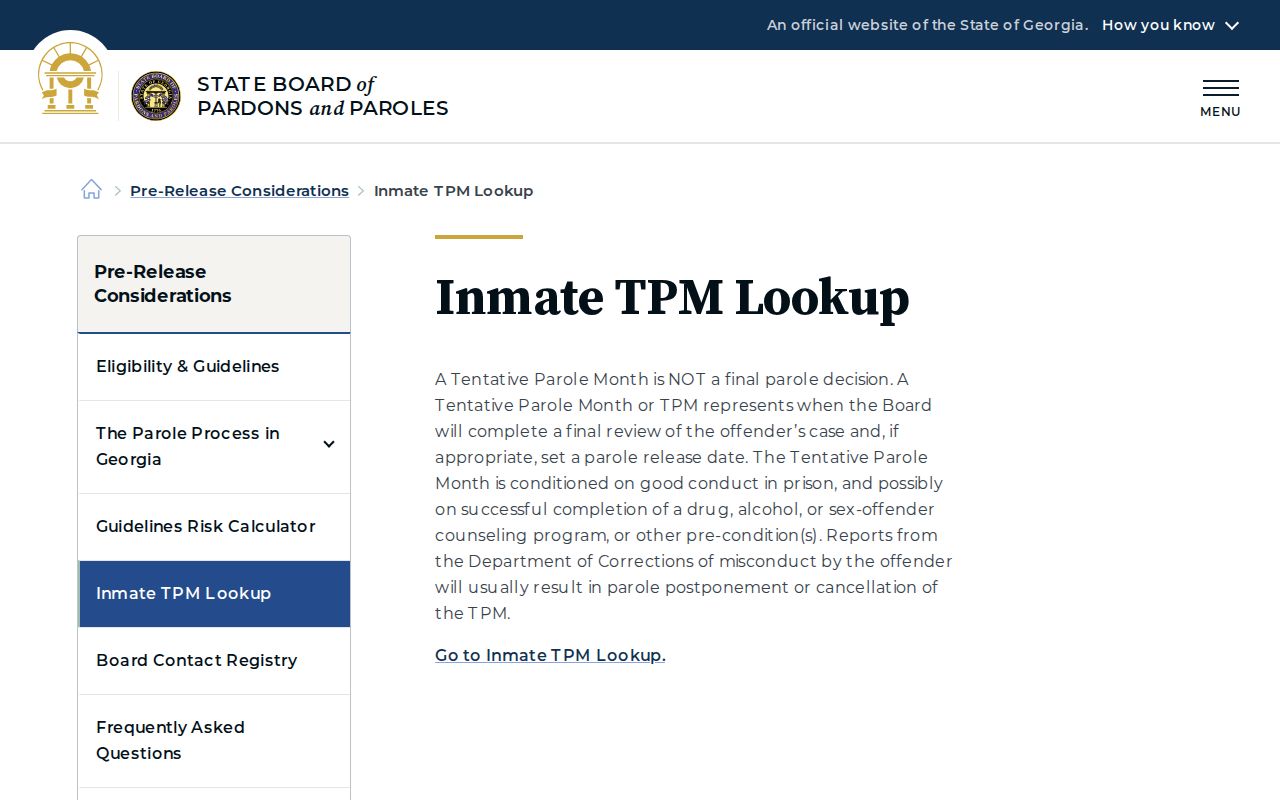
The official wording makes clear that the month is not a final parole decision.
Georgia Credits and Polk Release Dates
There is no supported single 85 percent rule for every Georgia inmate. O.C.G.A. 42-9-45 generally places parole consideration for many felony inmates after nine months or one-third of the sentence, whichever is greater, subject to exceptions. O.C.G.A. 17-10-6.1 restricts parole for listed serious violent felonies.
GDC's Performance Incentive Credit program says eligible offenders can earn one to twelve months off a TPM or Maximum Release Date through case-plan work, education or vocational progress, and work assignments. Statutory work incentive credits under O.C.G.A. 42-5-101 recognize education, work, and satisfactory behavior. These state rules are not a public Polk jail good-time formula.
GDC's PIC page shows the state computation feature.
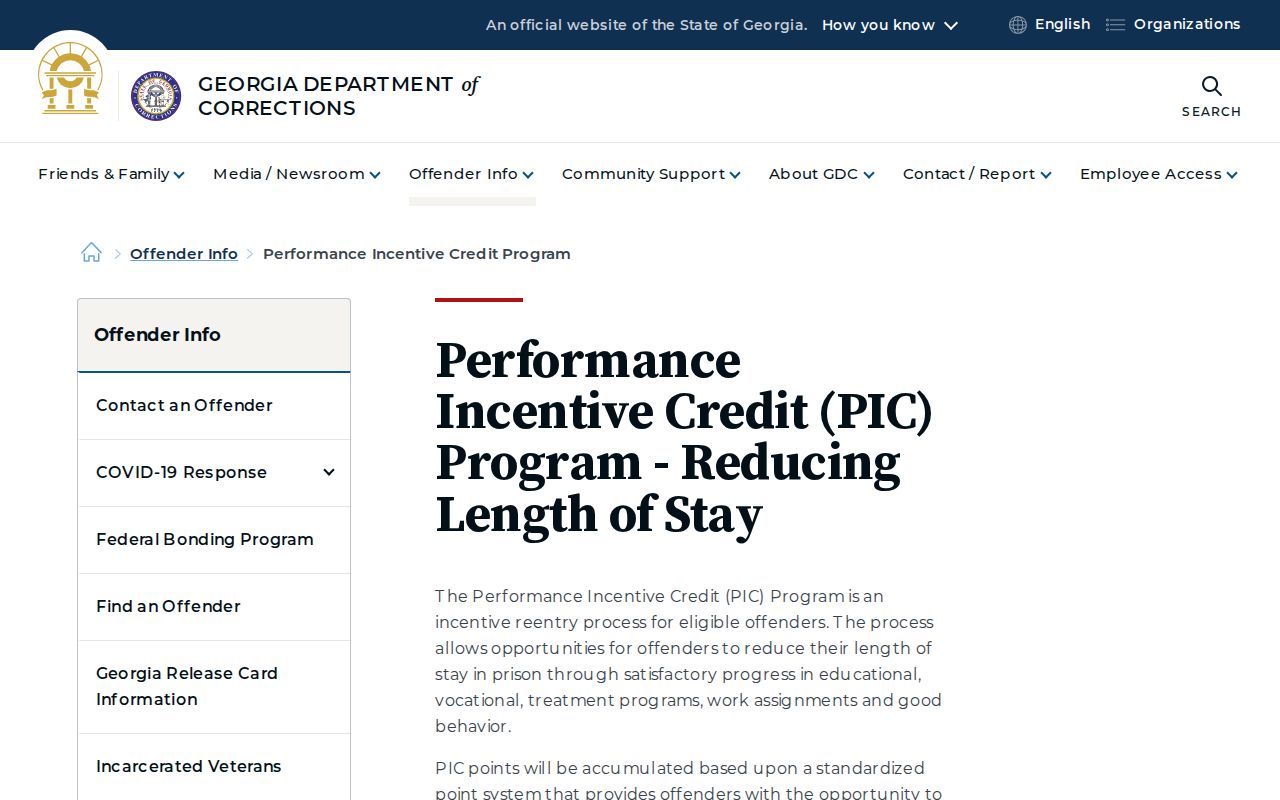
The capture ties earned credit to either a TPM or maximum date, not to a guaranteed release day.
Why Polk Release Timing Changes
A date can move because different legal and agency events affect custody.
| Factor | Possible effect |
|---|---|
| Misconduct | TPM may be postponed or canceled |
| Programs or PIC | Eligible state timing may advance |
| Detainer | Release may become transfer to another agency |
| Court order | Bond, sentence credit, or amended terms may change county timing |
| Board decision | Parole may be denied, changed, or conditioned |
| Residence plan | Approval may be required before parole release |
The Board retains discretion until the effective release date. A Polk jail departure can also be a transfer to GDC, BOP, ICE, or another county.
Confirm Polk County Release
Use Georgia VINELink for an available custody-change alert, then verify with the agency. For Polk County Jail, request the release record or consult the court order. For a Georgia prisoner, check GDC and the Parole Board. A parolee record may confirm that state-prison release occurred while supervision continues.
Do not infer release from disappearance alone. A spelling error, feed lag, restricted record, or transfer can produce the same result. Actual release is established by the custody status and the originating record.
Georgia TPM and PIC Interaction
Georgia's distinctive timing rule is that PIC can affect a TPM even though the TPM is not itself a release date. The Board describes it as a final-review month conditioned on conduct and possible program completion. GDC describes PIC as a reduction of one to twelve months for eligible people.
Read the two values together but keep their roles separate. PIC may move the planning point. The Board may still postpone, cancel, deny, or change parole before the effective release.
Polk Jail Versus State Dates
Polk County Jail holds people awaiting court action, serving local terms, or waiting for transfer. Its public system is booking based. The pages list arrest date, arresting agency, days in jail, bond, charges, court, and current or released status. They do not expose the sentence worksheet or a future release-date field. A county booking may end through bond, time served, a judge's direction, sentence credit, or transfer. The displayed days in jail can describe elapsed custody, but it cannot calculate time left.
GDC manages sentenced state prisoners. Its public offender tools and the Parole Board systems address institutional status, parole review, and state release timing. A person can disappear from Polk's live roster because GDC accepted custody. That is a county-jail release event, but it is not a release from incarceration. The clean verification flow is Polk jail status, court judgment, GDC status when a state sentence is possible, TPM status when parole applies, and then a completed custody-change record.
The court named on Polk's charge line helps route the search. Superior Court, Probate Court, Cedartown Municipal Court, and Rockmart Municipal Court do not all keep identical records. Ask the named court for the judgment or later order that controls the local sentence.
Georgia Parole Eligibility Rules
Eligibility and release are not synonyms. Under the general rule in O.C.G.A. 42-9-45, many parole-eligible felony inmates reach consideration after nine months or one-third of the sentence, whichever is greater. The Board notes that few people receive parole at the first eligibility point. It may set a future TPM or deny parole entirely.
Georgia's serious violent felony restrictions change that analysis. The Board states that people serving non-life sentences for listed serious violent felonies with crime dates on or after January 1, 1995 are not eligible for parole consideration. Life-sentence eligibility depends on the crime date under published historical rules. Those provisions concern state parole. They should not be applied as a shortcut to a short county-jail term.
Most eligible Georgia prisoners receive automatic Board consideration. An application is not what creates the TPM. The Board reviews the file, investigation, offense severity, risk information, conduct, and other legally relevant material. Its result remains subject to change until the effective release.
Confirm a Polk Jail Date
For a fresh county event, the Polk 24 Hours Arrests page can show a recently booked person with Status: RELEASED. The arrest-date range can show older bookings with the same status. Neither view supplies a separate release timestamp or reason. If the exact date or legal basis matters, request the booking and release record from the Sheriff's Office or the Polk County records channel.
A public bond amount does not prove that bond was posted. One day in jail also appears for people who remain booked and for people already released. Read the status field, then consult the court docket or release record for the event. A court order may show bond, time served, sentence credit, dismissal, or another disposition that explains the timing.
Polk Superior Court provides public terminals and routes certified-document access through Georgia court systems, but the clerk does not perform criminal searches by phone, fax, or email. A case number and the correct court save time. General county open-record requests and certified court requests follow separate routes.
Planning Around Polk Release Timing
A TPM may help with cautious planning, but it should not support a firm pickup time. Misconduct can postpone or cancel the month. Rehabilitative work may advance it by a few months. Program completion can be a precondition, and an acceptable residence plan may still be needed. The Board can change a prior decision up to release.
Detainers create another limit. A detainer is a request or legal basis for a second agency to take custody. It can turn the end of a Polk or GDC hold into a transfer to another county, federal custody, or immigration custody. The first system may truthfully show release while the person remains confined elsewhere.
Verify again near the expected event. Use the holding agency for actual custody, the court for orders, GDC for a state sentence, and the Board for parole timing. Automated notification is helpful, but a direct agency record remains the final source.
Polk Release Date Terms
Exact agency terms prevent false certainty.
- Projected release date
- A calculated or expected future date that may change.
- Tentative Parole Month
- The month when the Georgia Parole Board expects final review, not a parole promise.
- Maximum Release Date
- A sentence-based end point maintained in the state correctional process.
- Performance Incentive Credit
- A GDC program that can reduce a TPM or maximum date for eligible offenders.
- Actual release
- The completed departure or transfer recorded by the custody agency.
The phrases often grouped under “good time” are not interchangeable. County jail credit, statutory work incentive credit, PIC, and a Board decision come from different authorities. A reliable Polk County projected release date cannot be found by subtracting a generic percentage from the sentence.
Written verification is useful when public fields are unclear. GDC directs questions about offender information to Inmate Records and Information at PO Box 1529, Forsyth, GA 31029. A focused inquiry should identify the person and ask which published date or status is being verified. For Polk County Jail, use the Sheriff's Office or county request channel instead because GDC does not calculate a local jail release.
After release, the best confirming record changes again. A parolee may appear in the Georgia Parolee Database and report through DCS. A person who completed the full prison term may have no parole supervision. Someone released on probation follows the sentencing court and the appropriate felony or misdemeanor office. The projected-date search should end with the agency that records the actual next status.
Keep a short source log when the date matters: note the system checked, the displayed term, the date checked, and the agency named on the record. Then compare the next update using the same identifiers. This avoids mixing a Polk County booking date with a GDC maximum date or a Board TPM. If a field changes, the responsible agency can explain its own record more reliably than a second system can.
Release timing is personal to the sentence and custody history. Two people booked on the same day can have different bond orders, credits, holds, sentences, and parole eligibility. Use public dates as record fields, not as a formula for someone else's case.