
Polk Parole Versus Probation
Release from custody does not always end a sentence. Parole allows an eligible state prisoner to serve part of a sentence in the community under a decision by the Georgia State Board of Pardons and Paroles. Probation is imposed by a court. In Polk County, felony probation and parole are supervised through the Georgia Department of Community Supervision, while local misdemeanor probation follows the Polk County Probation Office route.
| Status | Who orders it | Polk County contact |
|---|---|---|
| Parole | State Board of Pardons and Paroles after state imprisonment | Cedartown DCS Field Office |
| Felony probation | Sentencing court | Cedartown DCS Field Office |
| Misdemeanor probation | Sentencing court | Polk County Probation Office |
A jail status of RELEASED proves only that Polk County Jail no longer holds the person. It does not show whether parole, probation, a transfer, or another condition followed. The court disposition, Board database, and supervising office supply those separate facts.
- Parole
- Conditional community release during a state-prison sentence.
- Probation
- A court-ordered sentence served in the community under stated conditions.
- Discharge
- The formal end of a supervision term.
- Absconder
- A supervised person reported as no longer maintaining required contact.
Verify Polk Post-Release Supervision
Use the source that owns the record. The Georgia Parolee Database is the direct public path for a person already released on parole. The Board's Inmate TPM Lookup concerns a person still awaiting possible parole and is not proof of release.
- Check the Polk jail roster to separate current county custody from release.
- For parole, search the Parolee Database and compare identity details carefully.
- For felony probation or local parole reporting, contact the Cedartown DCS office.
- For misdemeanor probation, use the Polk County Probation Office instructions.
- Use the sentencing court record when the supervision type or term remains unclear.
The Board's parole process explains that eligible cases receive file review and Board votes. Ordinary parole consideration is not a routine Polk County courtroom hearing. A tentative parole month can be changed before release, so it must not be read as present supervision.
Polk County Supervision Offices
Polk County has two distinct reporting routes. The Cedartown DCS Field Office serves Haralson, Polk, and the Tallapoosa Circuit for felony community supervision. The Polk County Probation Office says misdemeanor reporting is by appointment only and sends felony inquiries to DCS.
100 County Loop Road, Suite A
Cedartown, GA 30125
770-749-2206
Monday-Friday, 8:00 a.m.-4:30 p.m.
Reporting by appointment only
770-749-2929
Felony inquiries: 770-749-2206
Call before appearing. An office can confirm reporting instructions for the person involved, but public access may not include every case note, condition, or personal detail.
The official Cedartown field-office listing shows the local Polk County service area.
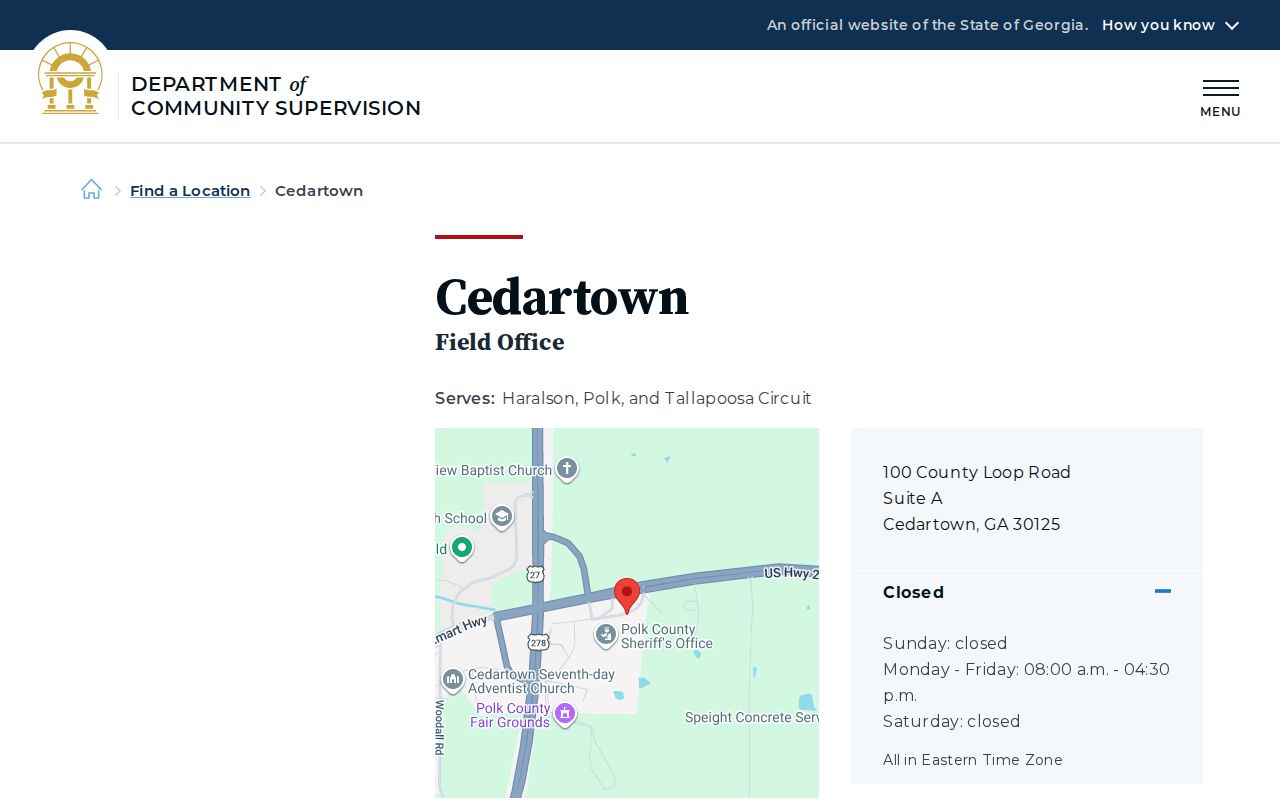
The capture identifies the office responsible for the local state-supervision route.
Polk Supervision Conditions and Violations
Conditions vary by sentence and Board order. They may govern reporting, residence approval, travel, programs, payments, or contact. Only the order and supervising officer establish the actual terms. A missed appointment does not by itself tell the public what action followed. DCS, the court, or the Board must confirm whether a violation report, warrant, revocation process, or changed instruction exists.
An absconder designation generally means the agency reports that a person stopped maintaining required supervision contact. It is not the same as a new conviction. Do not try to detain or confront anyone based on a database result. Provide current information to the responsible agency or law enforcement when safety is at issue.
Georgia VINE notifications may report custody changes in participating feeds, but VINE is not a complete supervision file. The Parolee Database and DCS remain the stronger post-release sources.
How Polk County Supervision Ends
Supervision ends through formal discharge, expiration, court action, or another agency decision applicable to the sentence. Leaving Polk County Jail does not start or end every term automatically. Likewise, disappearing from a public parole search is not enough to prove discharge. Request confirmation from the supervising authority and use the court record for probation dispositions.
Georgia's Open Records Act makes many agency records available, but exemptions and privacy limits can apply to supervision files. A public requester may receive a status record without confidential case notes, medical details, or security information. The Polk County released-inmate search path explains how jail, court, state custody, and release records fit together.
Georgia Release Card After Prison
A person released from GDC custody may receive remaining account funds through a Georgia Release Card. GDC says funds left on the person's books transfer to the card. It may be used at once for signature purchases, while ATM withdrawals, cash back, and PIN-based transactions require PIN activation.
This is a state-prison release detail, not a Polk County Jail practice. It can nevertheless help distinguish a GDC discharge from a county-jail release. The official Georgia Release Card information should be used for card procedures or problems.
Which Polk Probation Office?
Polk County's local split prevents a common routing error. A felony probation or parole question belongs with DCS in Cedartown. A misdemeanor probation reporting question belongs with the county office and is handled by appointment. The sentence class and court paperwork control the route, not the fact that both offices use the word probation.
For uncertain cases, begin with the sentencing court docket. Then call the matching office with the person's full name and case information. That sequence avoids treating a jail release flag as proof of either felony or misdemeanor supervision.
Polk Parole Board Records
The Georgia State Board of Pardons and Paroles decides parole for eligible state prisoners. It is separate from Polk County Jail, Polk Superior Court, and DCS. The Board's process uses file review, investigation, votes, tentative parole decisions, denials, and reconsideration. Ordinary parole consideration is not a routine adversarial hearing in a Polk courtroom.
For a person still in prison, the Inmate TPM Lookup may show a Tentative Parole Month. A TPM is the month for final review, not a final release date. The Board may postpone, cancel, withdraw, or change a decision before release. Once the person is released on parole, the Parolee Database is the more relevant public search.
The Board may establish a TPM or deny parole in non-life, parole-eligible cases. Life-sentence cases follow different eligibility rules. These systems explain state-prison parole, not misdemeanor probation or a bond release from Polk County Jail.
Polk Release and Supervision Records
Three records answer three different questions. The Polk jail record shows whether county custody ended. The court disposition shows the sentence and case outcome. The supervision source shows whether parole or probation remains active. A person can be released on bond with no supervision, released after time served with probation, transferred to GDC, or paroled from state prison. The word released does not identify which path occurred.
Start with the arresting agency and court fields in Polk's jail data. Superior Court, Probate Court, Cedartown Municipal Court, and Rockmart Municipal Court maintain their own case paths. When the judgment is unclear, obtain the court record before choosing a supervision office. The local probation page itself makes the felony and misdemeanor split explicit.
A supervision office may confirm public status and reporting instructions, but confidential case notes, medical information, risk material, and security details may be withheld. Ask for the specific status or record needed rather than an unrestricted case file.
Polk Parole Eligibility and Release
Georgia law controls parole eligibility. O.C.G.A. 42-9-45 generally makes many felony inmates eligible for consideration after nine months or one-third of the sentence, whichever is greater, subject to exceptions. Eligibility does not mean release. The Board notes that few inmates receive parole at their first eligibility point.
Serious violent felony restrictions under O.C.G.A. 17-10-6.1 can eliminate parole eligibility for covered non-life sentences based on the crime date. The Board also applies separate historical rules to eligible life sentences. These state rules should not be used to estimate misdemeanor probation or county-jail release.
After an effective parole release, DCS manages community supervision through the local field-office structure. A parolee must follow the actual certificate and officer instructions. Public summaries cannot define the conditions in a named person's order.
Confirm Polk Supervision Changes
Keep a source log when status matters. Note the person's identifiers, the database searched, the date checked, and the agency shown. Then confirm any change with the authority that owns the record. A missing online result can reflect spelling, an older record, a data refresh, discharge, or a move between systems.
VINELink can send custody-change notice when a person appears in a participating feed. It does not report the full parole or probation file. Likewise, Polk's live jail roster is not proof that supervision ended after release. Use DCS, the Board, local probation, and the court according to the sentence.