
Georgia Corrections Release Destinations
A person sentenced from Polk County may leave the county jail for a Georgia Department of Corrections facility. That move is a transfer, not release into the community. Once GDC accepts custody, the statewide offender record becomes the main public source. A later departure from prison may be parole, completion of the maximum term, or another authorized discharge.
Parole means conditional release before the sentence fully expires. The Georgia State Board of Pardons and Paroles decides parole. Someone released on parole may then report through the Department of Community Supervision. A person may also complete the prison term and leave without parole. The GDC search, Parole Board tools, and DCS office should be read together when the status is unclear.
Search Georgia Corrections Records
Open the GDC Find an Offender page, then continue to the offender-query form. GDC states that the search is designed to locate a person currently in one of its facilities. The agreement warns that available photographs display automatically. It also says the information is supplied for convenience and should be verified through written correspondence when an authoritative answer is needed.
- Enter the person’s name or GDC identifier when known.
- Compare identifying details before opening a record.
- Read the institution and custody information.
- Follow the Parole or Pardon Status link when it appears.
- Use written Inmate Records verification for a firm answer.
A no-result response does not prove a Polk County release. Check spelling, aliases, and identifiers. The person may remain in county custody, may have completed state custody, or may be in another system. The Polk County release-search path covers those local and federal alternatives.
The official GDC offender-query form shows the search agreement and available inputs.
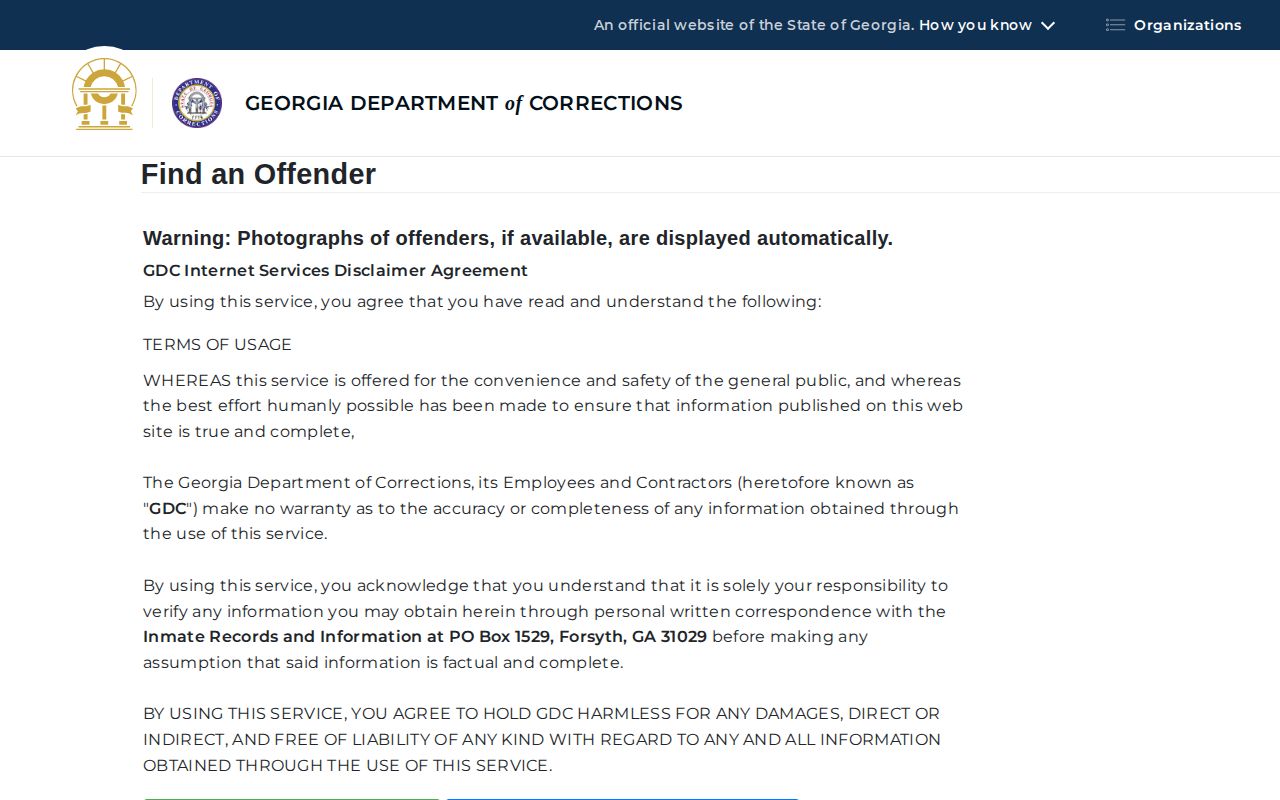
The form’s warning and search fields reinforce the need to select the correct person and verify important custody facts with GDC.
Georgia Corrections Records Contact
The public query is a starting point, not a certified discharge statement. GDC directs verification through its Inmate Records and Information office. Include the person’s full name, GDC number if known, and the exact custody or release fact that needs confirmation. A narrow request is easier to identify than a request for every document concerning a person.
PO Box 1529
Forsyth, GA 31029
Written verification route published in the offender-search agreement
Georgia also provides a GDC open-records request page. Use that state route for GDC-created records. Polk County NextRequest covers county records, not a state-prison discharge file.
About Georgia Corrections Search
This mapped page represents the Georgia statewide offender locator, not one prison building. It serves Polk County readers when a jail booking led to a state sentence or GDC transfer. The county roster should not be used to track someone after state custody begins.
GDC warns that its public data may not be complete or error free. Match more than a name. The query form may expose identifying and custody details plus links connected with parole status. Because photographs may appear without another prompt, users should expect an image when GDC has one.
Read Georgia Offender Fields
Search fields help separate people and locate the correct correctional record. Name is the most common entry point, but a state identifier is stronger. The institution tells where GDC reports custody. Status and sentence information must be read in context because a parole-related date is not always a final release date.
| Item | Use |
|---|---|
| Name and identifiers | Confirm the correct person before relying on status. |
| Institution | Shows the GDC location reported by the system. |
| Sentence details | Describe the state sentence, not the Polk booking alone. |
| Parole or pardon link | Routes eligible records toward Board information. |
| Photograph | May display automatically when available. |
Dates can change for lawful reasons. Never convert a tentative month into a promised release day. Use the agency that owns each field for clarification.
Georgia Tentative Parole Month
The Parole Board’s Inmate TPM Lookup addresses possible parole timing. TPM means Tentative Parole Month. It is a final-review month, not a guaranteed release date. The Board may postpone, cancel, withdraw, or change a parole decision before release. For eligible non-life cases, the Board may establish a TPM or deny parole; life-sentenced cases follow a different grant-or-deny framework.
Parole eligibility and a parole grant are also different. Georgia law and Board rules govern when review may occur. Serious violent felony restrictions can change eligibility. The public lookup can help explain where review stands, while the Board remains the source for its decision.
Georgia Credits and Release Dates
GDC’s Performance Incentive Credit program can affect eligible state offenders. The agency says eligible participants may receive from one to twelve months of credit against a Tentative Parole Month or Maximum Release Date. A maximum release date marks the sentence endpoint used by corrections. PIC does not turn every projected date into a fixed promise.
Work incentive credits under Georgia law and parole review operate under distinct rules. Conduct, program participation, sentence structure, detainers, and Board action can affect timing. For that reason, compare the current GDC record with the Board’s current TPM information rather than relying on an old saved result.
Verify Georgia State Discharge
A released or discharged state offender may no longer appear as an active GDC prisoner. Confirm the result through Inmate Records when the public page does not supply enough detail. The desired state record may include the release or discharge date, authority, sentence information, and status maintained by GDC.
Then check supervision. A person can be out of prison yet remain on parole or felony probation. The Parolee Database addresses people already released on parole. DCS locally serves Polk County through the Cedartown Field Office. Local misdemeanor probation is different and belongs to Polk County’s probation office.
Georgia Release Card Funds
GDC documents a Georgia Release Card for funds left on a person’s books after release from state custody. The agency says transferred funds may be used at once for signature purchases. PIN activation is required for ATM use, cash back, or PIN-based transactions. This is a state-prison release detail and should not be presented as a Polk County Jail practice.
The card explains how remaining account funds may follow a released state offender. Questions about the card belong with the GDC release-card information route. It does not establish custody status and should be checked only after the release itself is verified.
Separate Polk and State Records
The Polk jail record documents booking and departure from local custody. The GDC record documents state correctional custody. A court file records the sentence and disposition, while the Parole Board records its own decisions. One source should not be forced to answer every question.
Build a timeline from the Polk arrest date, county release or transfer, GDC admission, sentence details, parole review, and final release or discharge. When dates conflict, request verification from the office that created the disputed entry. That approach is more sound than assuming the county roster should retain a person after transfer.